Collaborating
to advance
climate action
Achieving our net zero goal requires collaboration across our value chain, especially with our suppliers on our Scope 3 emissions, which are outside of our direct control.
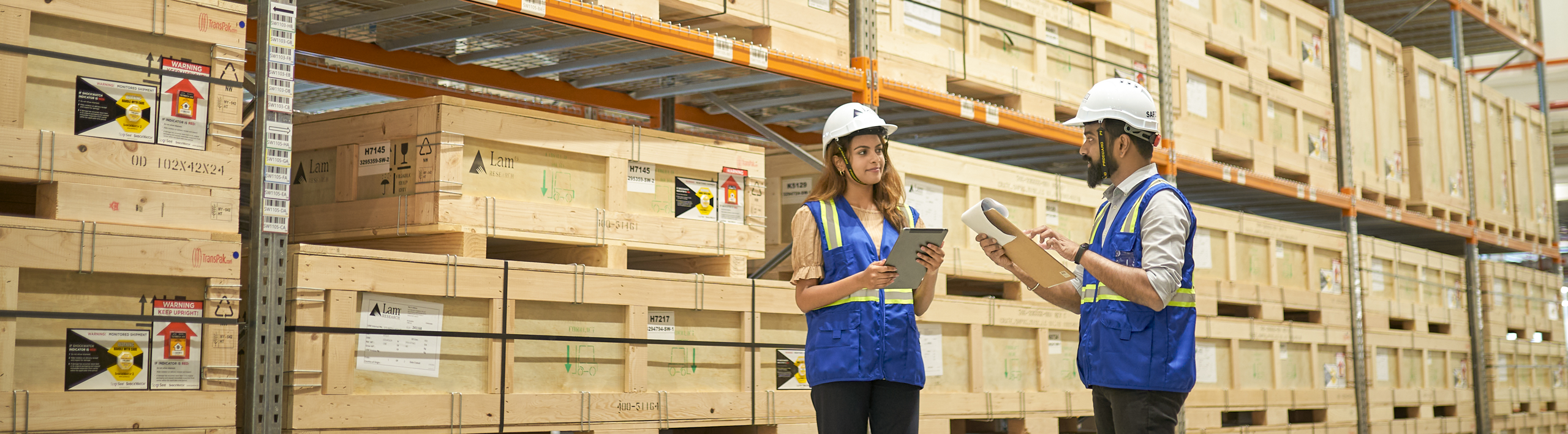
At Lam, propelling technology forward goes hand in hand with cultivating a responsible supply chain that supports our business, as well as our values and social and environmental ambitions. We aspire to hold ourselves and our suppliers accountable for conducting business responsibly and ethically. This is integral to our overall business strategy—making Lam’s value chain more competitive and resilient.
Achieving our net zero goal requires collaboration across our value chain, especially with our suppliers on our Scope 3 emissions, which are outside of our direct control.
We strive to support and protect human rights throughout our global operations, including within our supply chain.
We exercise due diligence with our suppliers to promote the responsible and ethical sourcing of raw materials, including conflict minerals.
It’s a complex network that requires strong oversight and governance to manage. Our approach is to engage closely with suppliers throughout the supplier lifecycle, from pre-selection to onboarding and beyond. We aspire to cultivate strong supplier relationships built on shared values, transparency, and mutual trust.

Our global supply chain executive leadership oversees responsible supply chain governance, while a dedicated program management team implements our efforts with support from a global, cross-functional team. We are a member of the Responsible Business Alliance (RBA), a relationship that underpins our responsible supply chain program.
For Lam, effective supply chain management allows us to:
Lam strives to engage with suppliers throughout our relationship. We use country-level risk data to inform our overall direct supplier engagement and assessment strategy.

Before contracting with a supplier, Lam conducts due diligence using a risk-based approach.
We’re an active member of the Responsible Business Alliance (RBA), and support its vision and mission. Beginning with supplier pre-selection and onboarding, we require that every supplier adheres to our Global Supplier Code of Conduct, the RBA3 Code of Conduct, and all applicable laws and regulations. We also encourage them to become RBA members.
Lam Research
Our proven delivery performance is achieved with ethical supplier management and business operations. Every Lam direct material supplier is contractually obligated to comply with our GSCC, which is communicated through the MyLam® portal, and is subject to regular internal reviews by our Supply Chain Management team. In addition, the Code is translated into several languages and posted on our website.
Open and honest communication is one of our Core Values and is our standard practice. We encourage our employees, suppliers, and other non-Lam employees to help us proactively recognize Ethics and Compliance related issues by asking questions, expressing concerns, making disclosures, or filing reports through channels including the EthicsPoint Helpline.
We aim to achieve net zero emissions by 2050. Driven by this goal, we are collaborating closely with our suppliers to reduce Lam’s Scope 3 (and, therefore, our suppliers’ Scope 1) emissions. We are working to reduce direct supplier emissions by 64% per USD value added by 2034 from a 2024 baseline.1
Through our supplier engagement platform, we survey our top 100 suppliers1 on categories including greenhouse gas emissions, CDP scores, environmental goals, ISO 14001 certification, and RBA3 membership status. This data has enabled us more effectively engage with our suppliers on environmental topics.
Every individual deserves safe working conditions and to be treated with dignity and respect. We strive to support and protect human rights throughout our global operations, including within our supply chain. This work aligns with our Core Values, our GSCC, and our Human Rights Policy, and it supports our commitments to our customers.
Lam’s global Human Rights Policy applies to all employees. Our GSCC reflects the policy’s principles, and we expect our suppliers, as well as our business and community partners, to adhere to them. We also expect our suppliers and their sites to comply with laws that include, but are not limited to, the U.K. Modern Slavery Act of 2015 and the California Transparency in Supply Chains Act of 2010.
Our human rights management process is informed by the RBA, making use of suppliers’ SAQs and their participation in VAP audits to drive continuous improvement. In addition to helping us check compliance with our GSCC and the RBA COC, SAQs and review of VAPs ensure our suppliers are mitigating potential human rights risks. The management process also helps us meet our customers’ expectations for supply chain human rights. Our Global Employment Practices Statement declares our support of workers’ rights to freedom of association and collective bargaining, to the extent permitted under local laws. We also align with the RBA’s3 Responsible Labor Initiative, which is focused on ensuring that the rights of workers vulnerable to forced labor in global supply chains are consistently respected and promoted. We ask our top suppliers to complete human rights training through the RBA3 platform and have launched internal training for certain Lam employees in global supply chain management.
Our aspiration to uphold global human rights extends to our strategy for responsibly and ethically sourcing raw materials. This strategy includes our membership in the RBA’s RMI, a multi-stakeholder organization that helps address human rights issues in the mining of conflict minerals and other minerals of concern. We leverage RMI’s CMRT to collect data from our suppliers, and we then include that data in our annual filings to the U.S. Securities and Exchange Commission (SEC).
In order to address growing international concern over the violence and human rights abuses that are being fueled by mining operations controlled by armed militias in the Democratic Republic of the Congo (DRC) and neighboring countries (collectively, the “Covered Countries”), the United States has adopted legislation under Section 1502 of the Dodd-Frank Wall Street Reform and Consumer Protection Act (the “Act”) pertaining to certain “conflict minerals”, including tin, tantalum, tungsten, and gold (and their derivatives). The Act, as implemented by the U.S. Securities and Exchange Commission’s final rules (the “Final Rules”), requires certain public companies whose products contain these “conflict minerals” to make annual disclosures and conduct reasonable due diligence on their supply chains to determine the sources of such conflict minerals.
Lam Research fully supports the intent of Section 1502 of the Act. Lam has a complex supply chain and relies heavily on its partnerships with suppliers to purchase certain products or components from around the world that may include conflict minerals. Like many other companies in the electronics industry, Lam does not directly purchase the conflict minerals contained in its products or have any direct relationship with the mines or smelters that process them. As a result, we have been working closely with our suppliers since late 2012 to determine the sources of any conflict minerals that are contained in our products. Lam takes corporate responsibility seriously, and it is our goal to use in our products only conflict minerals that are sourced responsibly, including any conflict minerals that may be sourced from the Covered Countries.
In support of this policy, Lam Research:
Lam’s Form SD filing and relevant Conflict Minerals Reports can be found on our SEC Filings page.